Terrence Keller

Emerging Sophistication

By the late 1980’s, Keller had established a uniqueness to his art.  In fact, he had hit a new level of sophistication that’s tied to his innovative use of paint material.

In the pieces created during this time, one is always aware of the fullness of the grounds and the way Keller scraped and puddled the liquid paint to create a rich configuration of tonal and colouristic incidents.  It seems there is often a subtle counterpoint relations between the  drawings in the ground and that of the gel overlayer.

Keller’s paintings became more grandly conceived, bolder and clearer in their visual effects. Working with the repeatable formats gave him a better hold on his ideas which in turn, provided more flexibility in his approach.

He now saw the format as the facilitator rather than as some sort of stylistic signature.  He benefited from his ability to pick and choose between motifs or abandon them altogether if it seemed useful.

Keller’s smaller paintings were less tied to pre-set layout designs, although they too were affected but the trend toward “clarity” that emerged was in the larger, horizontal paintings.

Innovative Style

As a result of this new “clarifying” of his ideas, he reintroduced complication in his paintings without sacrificing the new immediacy of the contemporary effect he’s discovered.

Several of his works of this time illustrated the new innovative technique.  Similar to his “sweep” paintings of earlier years, these new works also have the thick paint pushed to the bottom and side edges.

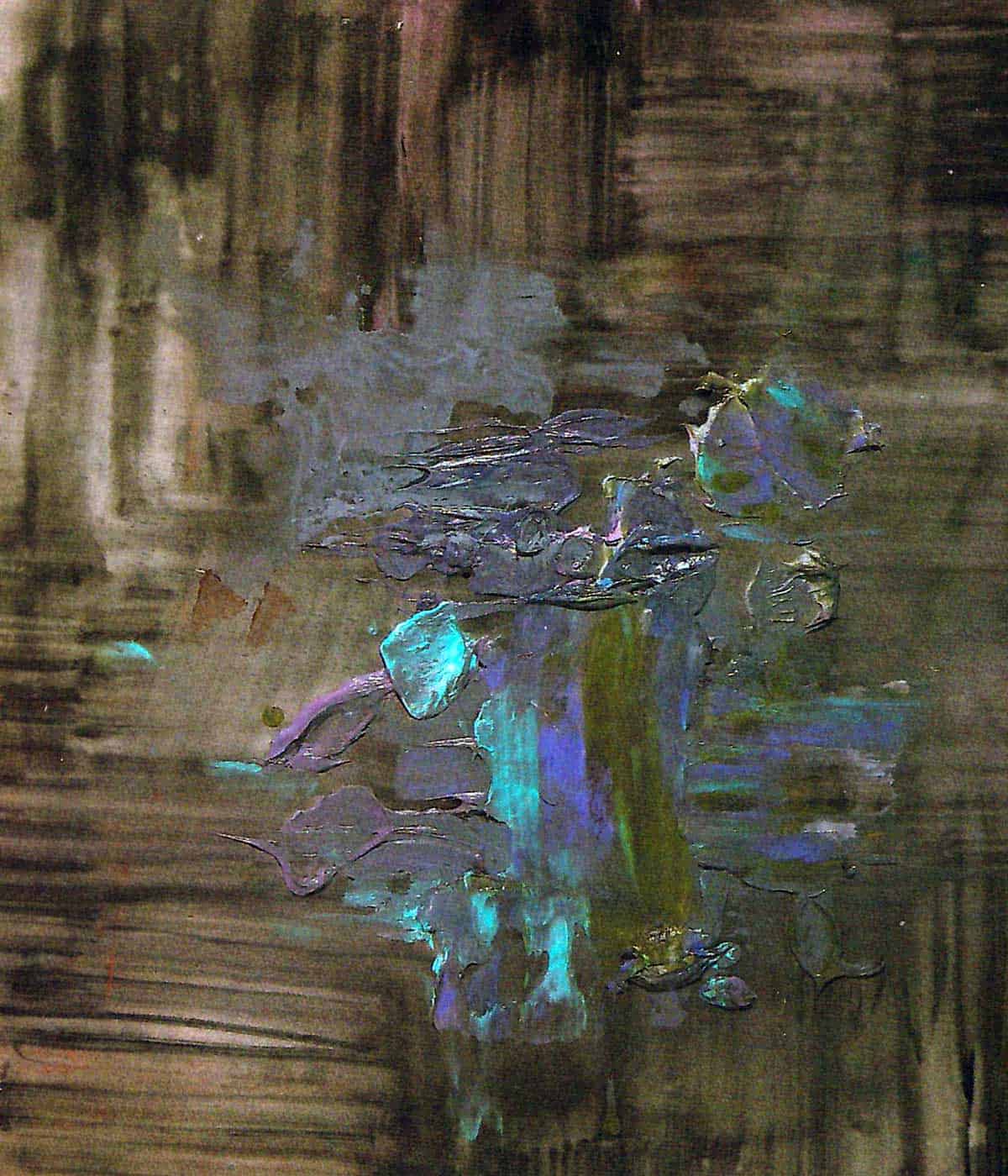
His painting called Navajo, 1988  was one of his pieces that used this technique.

NAVAJO
1988

Acrylic on canvas
174.0 x 141.6 cm

Courtesy of the
Woltjen/Udell Gallery

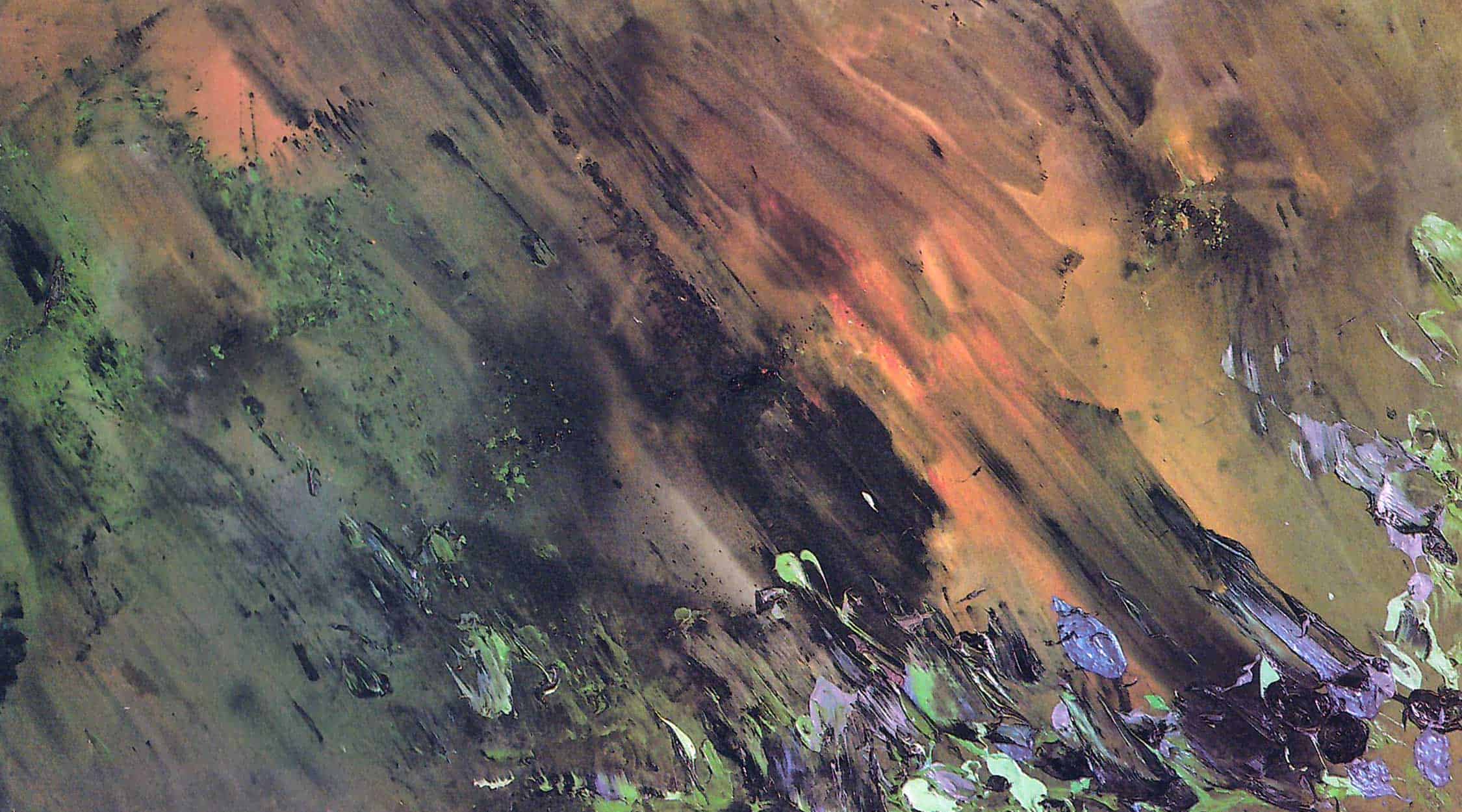
GARDEN EDGE
1988

Acrylic on canvas
145.5 x 274.3 cm

Courtesy of the
Woltjen/Udell Gallery


Consider also his piece called Garden Edge, 1988.  The paint figuration was arranged like a fanning cascade that pours diagonally across the canvas to create a sensation of rushing movement held in check and contained only by the picture rectangle.

Notice how the directional brushwork in the ground painting was closely related to the “movement” of the thicker paint on top.  The counterpoint interaction of thick and thin paint application was sacrificed to achieve something dramatically charged, yet unified in effect.

As in previous works, this painting exploited a motif design, yet it didn’t depend on the its layout to organize its spatial logic.  In reality, the logic was established almost totally by the handling of colour.  Full of vibrant colour and daring tonal contrasts, the painting seemed to be on the verge of visual incoherence.

The great idea Keller had about what he was doing truly allowed him to control all the fundamentals of his art.  He works at this stage, clearly demonstrated a new concentration or focusing on his conception.

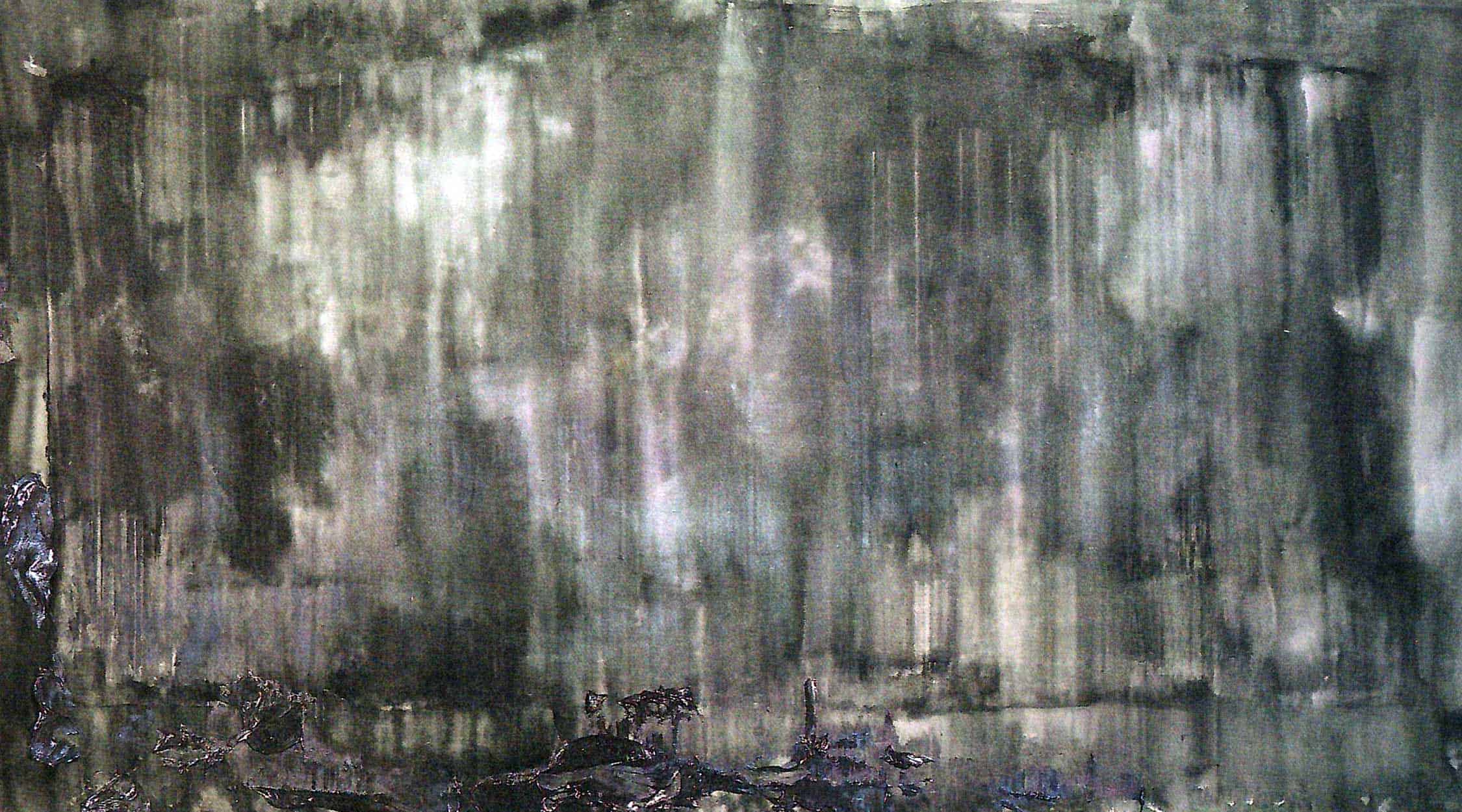
King Fisher, 1988, was just one of the pieces that revealed Keller as a mature, original artist.  This was just one his best paintings at this point of his career.

He was recognized in Alberta as a painter that counted in an important way.

He now had the advantage of working in a vital, yet challenging artmaking environment.  For anyone interested in making serious abstract art, Edmonton seemed to be the best place to be.  He was definitely in the right place.

Much credit, however, must go to Keller himself – to his single-minded application and his taste.  He had the good sense to follow his instinct regarding his art, and it never let him down.

KING FISHER
1988

Acrylic on canvas
144.2 x 264.2 cm

Courtesy of the
Woltjen/Udell Gallery


Works Cited:

Gerald J. Gongos (Supervisor of Publications), et al., Terrence Keller, (Edmonton, AB: The Edmonton Art Gallery, 1988)

Harry Korol (Photographer), et al., Terrence Keller, (Edmonton, AB: The Edmonton Art Gallery, 1988)

Roald Nasgaard, Abstract Painting in Canada, (Vancouver, BC: Douglas & McIntyre Ltd, 2007) 299-306.

Sydney Sharpe, Alberta: A State of Mind, (Toronto, ON: Key Porter Books Limited, 2005) 187-190.

Mary-Beth Laviolette, An Alberta Art Chronicle: Adventures in Recent & Contemporary Art, (Canmore, AB: Altitude Publishing Canada Ltd, 2006) 149-173.

Terry Fenton, Terrence Keller, (Sharecom, 2000) http://www.sharecom.ca/fenton/keller.html.

Art Gallery of Alberta, Terrence Keller, (AGA) https://www.youraga.ca/bio/terrence-keller.

Terry Fenton, Terrence Keller, (The Canadian Encyclopedia, 2006) https://www.thecanadianencyclopedia.ca/en/article/terrence-keller.

Terrence Keller, (2014) https://www.connelly-mckinley.com/obituaries/terrence-keller/.